Perpetual trading sounds super complex, but the idea is actually simple: It’s a way to bet on crypto prices going up or down without owning the coins, using a special contract that never expires and can use leverage to multiply your gains (and losses).
This beginner‑friendly guide explains:
- What perpetual trading (also called perpetual futures or perpetual swaps) means
- How perpetual contracts work step by step
- Key concepts like leverage, margin, liquidation, and funding rate
- Real‑life style examples so it makes easier you to understand Perpetual Trading in cryptocurrency
The goal is simple to make you understand how Perpetual Trading actually works in crypto with examples, so to kill any kind of confusion.
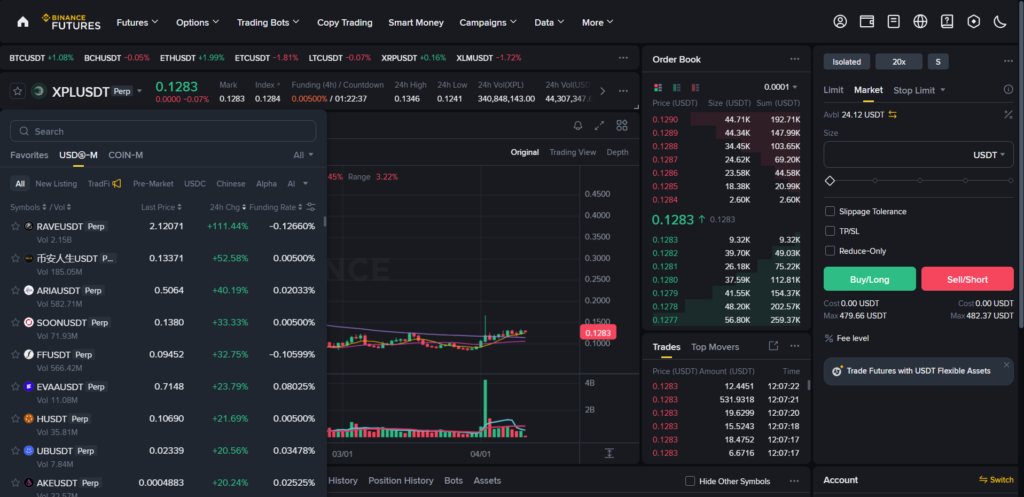
The most reliable platform for Crypto Perpetual Trading. Needs KYC!! – Binance | Bitget | Gate | MEXC
If you are a DEX user (Web3 Wallet user) you can use, anyone of these – Pacifica | Hotstuff | Extended | Paradex | GRVT
1. What Is Perpetual Trading in Crypto?
Easy definition
A perpetual futures contract (or perpetual swap) is:
A crypto trading contract that lets you bet on the price of a coin (like Bitcoin or Ethereum) without owning it, and the contract never expires.
You can:
- Go long = bet the price will go up
- Go short = bet the price will go down
Unlike normal futures, there is no expiry date, so you can keep the trade open “forever” as long as you have enough money (margin) in your account.
But it is not a prediction platform like Predict.fun, because we are trading perpetual contract.
In real-life terms, perpetual trading is
Let’s understand perpetual trading with an example. Imagine a game:
- You and a friend make a deal based on Bitcoin’s price.
- You say: “I think Bitcoin will go up.” (You’re long.)
- Your friend says: “I think it’ll go down.” (They’re short.)
- You don’t actually buy any Bitcoin. You’re just tracking the price and settling the difference in dollars or stablecoins later. It’s never about buying that specific coin/crypto.
That deal between you two is like a perpetual futures contract.
2. How Perpetual Trading Works (Step by Step)
Let’s break down how perpetual trading in crypto works using a simple step‑by‑step flow.
Step 1: You choose a market
Example: BTC/USDT Perpetual
- Underlying asset: Bitcoin
- Settlement asset: USDT (stablecoin)
- You’re not buying real BTC; you’re trading a derivative (a contract based on BTC’s price).
Step 2: You decide long or short
- Long (Buy): You think BTC price will go up
- Short (Sell): You think BTC price will go down
You’re not buying coins, just betting on direction.
Step 3: You choose leverage
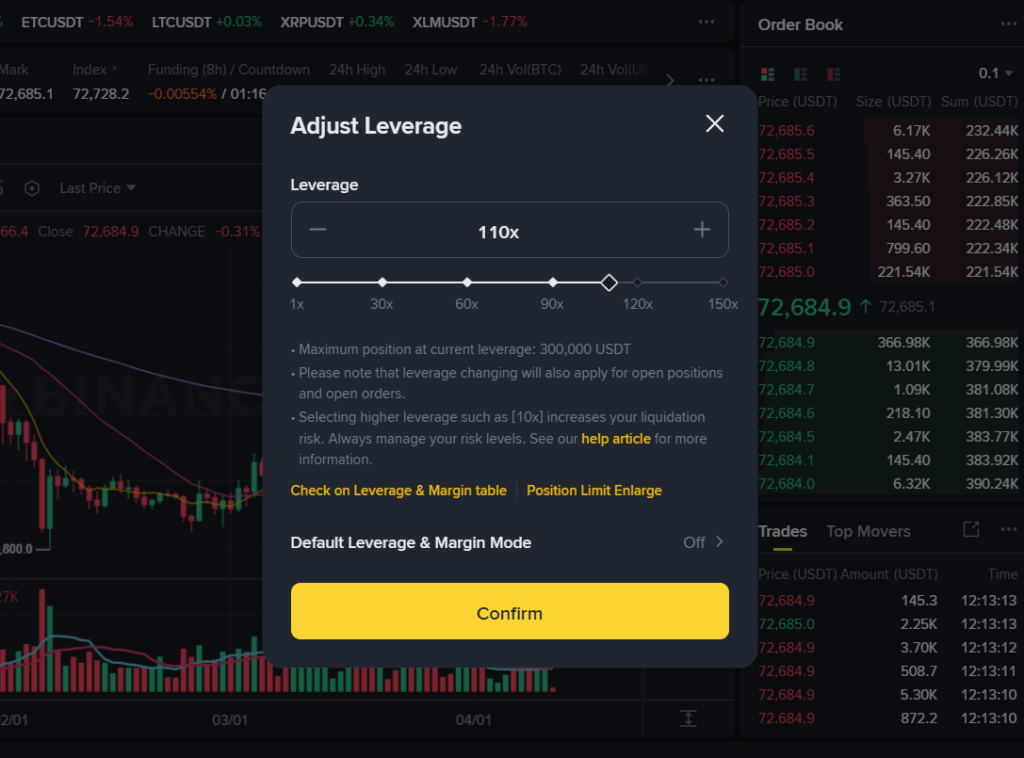
Leverage means you can control a bigger position with a smaller amount of money (margin).
- 1× leverage: No leverage – if you put in 100 USDT, you control 100 USDT of position
- 5× leverage: 100 USDT margin → control 500 USDT position
- 10× leverage: 100 USDT margin → control 1,000 USDT position
Leverage multiplies gains AND losses.
Step 4: You put in margin
Margin is like a security deposit.
- It proves you have some skin in the game
- If your loss gets too big, the exchange will liquidate (close) your position to stop you from going negative
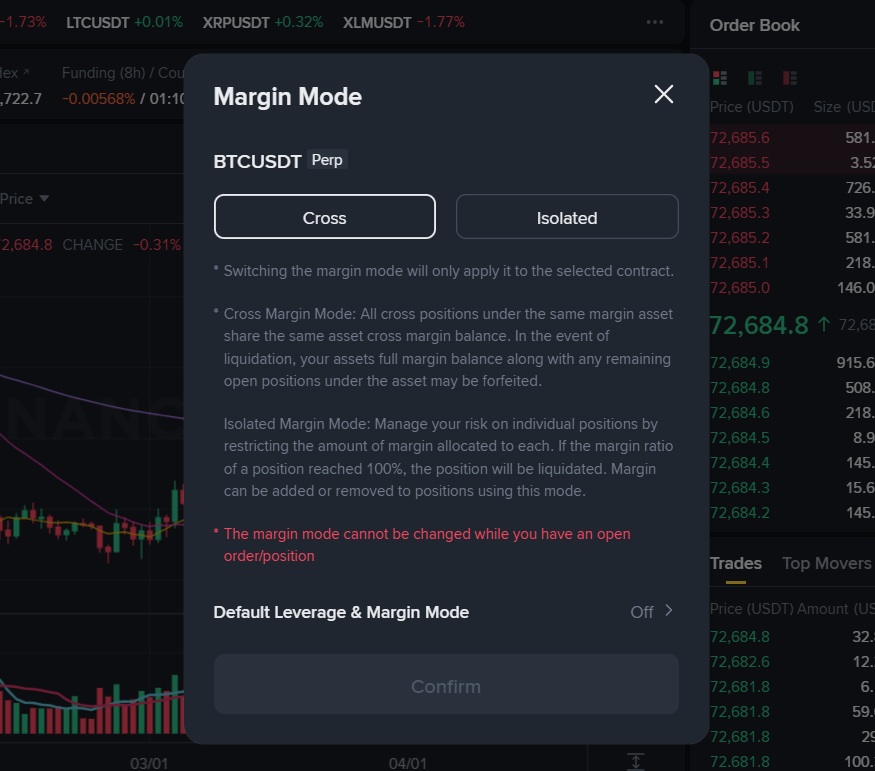
- Can be of 2 types, Isolated and Cross Margin.
What is Cross Margin in Binance Perpetual Future Trading
On Perpetual Futures, cross margin is like using your whole wallet for one trade.
If your trade loses money, it takes from your full balance to keep it alive.
Good: avoids quick loss.
Risky: you can lose everything, not just one trade.
What is Isolated Margin in Binance Perpetual Future Trading
On Perpetual Futures, isolated margin means you use only a small, fixed amount for one trade.
If the trade loses, only that amount is lost—not your whole wallet.
Good: safer.
Downside: trade gets liquidated faster.
Step 5: Price moves → profit or loss
If you are long:
- Price goes up → you make money
- Price goes down → you lose money
If you are short:
- Price goes down → you make money
- Price goes up → you lose money
You can close the position any time to lock in profit or loss.
Step 6: Funding rate kicks in
Because perpetual contracts never expire, they need a special system called the funding rate to keep the contract price close to the real spot price.
- If the perp price is above spot:
- Funding rate is positive → longs pay shorts
- If the perp price is below spot:
- Funding rate is negative → shorts pay longs
This payment happens every few hours (e.g., every 8 hours or every hour) depending on the exchanges eg. Binance.
Think of funding as a small fee or reward that pushes the price back in line with the real market.
3. Simple Example: Long Perpetual Trade With Leverage
Let’s walk through an example of what perpetual trading in crypto is and how it works with numbers.
Setup
- You have 100 USDT in your account
- You use 10× leverage
- So you open a 1,000 USDT long position on BTC/USDT perpetual at price = 20,000 USDT per BTC
Your position size:
- 1,000 ÷ 20,000 = 0.05 BTC (exposure, not real BTC)
Scenario A: Price goes up
BTC goes from 20,000 → 22,000
Profit ≈ 0.05 × (22,000 − 20,000) = 0.05 × 2,000 = 100 USDT
- You started with 100 USDT margin
- You just earned 100 USDT profit
- Return = 100% on your money with a 10% move in price
Leverage magnified your gains.
Scenario B: Price goes down
BTC goes from 20,000 → 19,000
Loss ≈ 0.05 × (19,000 − 20,000) = 0.05 × (−1,000) = −50 USDT
- You lose half of your 100 USDT
- If price keeps falling, you might hit liquidation
With enough move against you, the exchange closes your trade so your account doesn’t go to zero or negative.
4. Example: What Is Funding Rate in Perpetual Trading?
Let’s say:
- You are long a 10,000 USDT BTC perpetual position
- Funding rate is +0.03% per hour (positive)
That means:
- Longs pay shorts 0.03% of position value every hour
- 0.03% of 10,000 = 3 USDT per hour
If you stay in the trade for 24 hours, you’d pay about 72 USDT in funding that day (ignoring compounding).
Important:
- Funding can eat into your profit if you hold positions for days
- Sometimes you receive funding instead (if you are on the paying side’s opposite)
5. Perpetual Trading vs Normal Futures (Quick Comparison)
| Feature | Normal Futures | Perpetual Futures / Swaps |
|---|---|---|
| Expiration date | Yes (monthly, quarterly, etc.) | No, can hold forever |
| Need to “roll over”? | Yes, when contract expires | No roll over needed |
| Price convergence | Converges to spot at expiry | Kept near spot via funding rate |
| Holding time | Limited | Unlimited (if you keep margin) |
| Widely used in crypto? | Yes | Very popular for BTC/ETH/altcoins |
This “no expiry + funding rate” combo is exactly what makes perpetual trading in crypto special.
6. Why Do Traders Use Perpetual Trading?
1) Speculation (Betting on Price)
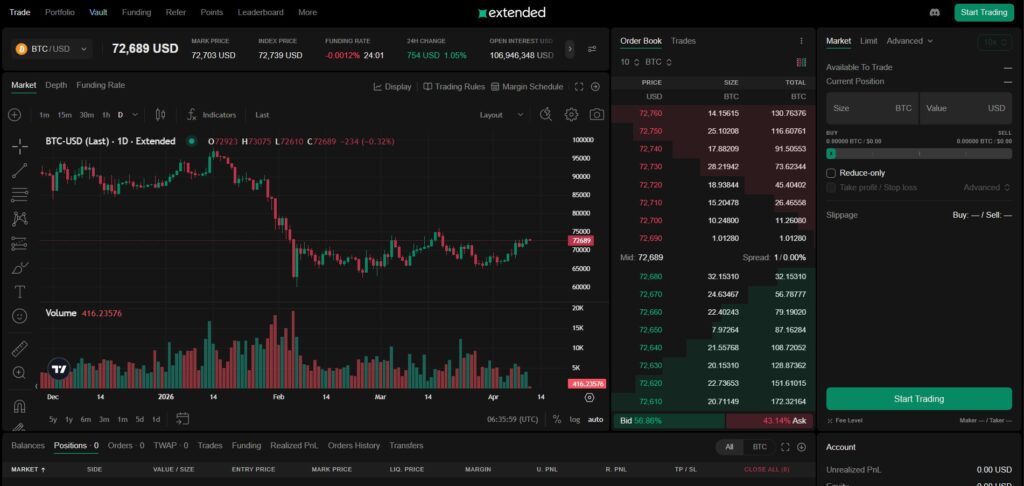
- Bet on Bitcoin, Ethereum, or altcoins going up or down. Use Binance or Extended(Web3) to trade majority of altcoins.
- Make money in bull and bear markets using long and short positions
2) Leverage
- Control bigger positions with less money
- Magnify gains (and losses)
3) Hedging (Protecting Your Bag)
- Example: You hold 1 BTC but are scared price might dump
- You can open a short BTC perpetual position
- If BTC drops, your spot BTC loses value but your short perp makes money → this reduces your net loss
4) 24/7, High Liquidity
- Crypto perp markets run 24/7
- Very high volume on major exchanges
- Easy to enter and exit trades quickly
7. Dangers and Risks of Perpetual Trading (Read This Twice)
Perpetual trading is powerful but very risky, especially with high leverage.
Big dangers:
- Liquidation:
If market moves too much against you, your position is auto‑closed and you lose most or all of your margin. - Over‑leverage:
Using 25×, 50×, or 100× leverage means even tiny price moves can wreck your account. - Funding rate drain:
Holding positions for days or weeks during heavy positive funding can quietly eat your profit. - Emotional trading:
Fast wins and losses make people tilt, revenge trade, and blow up accounts.
For a 14–17‑year‑old beginner, perpetual trading should be treated like:
- A learning tool (start in testnet/demo mode)
- Not a “get rich quick” button
8. Quick Safety Tips for Beginner Perp Traders
If you’re just learning what perpetual trading in crypto is and how it works, follow these rules:
- Start in demo/testnet mode
- Many platforms offer testnet perps with fake money, like – Binance Demo | Paradex Testnet
- Practice there first before risking anything real.
- Use low leverage (1–3× max)
- You don’t need 20–100× as a beginner.
- Lower leverage = more time to react.
- Risk tiny amounts
- Only use money you can afford to lose.
- Think of it as tuition for learning, not guaranteed profit.
- Always use stop‑loss orders
- Decide beforehand: “If price hits here, I’m out.”
- Don’t move your stop further away in hope.
- Respect funding rate
- Don’t hold heavy‑leverage positions for days without checking funding.
- Sometimes closing and reopening later is cheaper.
- Never trade just from FOMO or Twitter hype
- Learn basics: risk management, position sizing, support/resistance.
- Perps reward skill, not luck.
9. Final Summary: What Is Perpetual Trading in Crypto and How It Works?
To wrap up:
- Perpetual trading = trading perpetual futures contracts (perps or perpetual swaps) that track a crypto’s price without expiry.
- You can go long or short, use leverage, and trade 24/7.
- A special thing called the funding rate keeps perp prices close to the real spot price by making longs and shorts pay each other regularly.
- Perps are a powerful crypto derivative for speculation and hedging, but they carry high risk—especially for beginners.
If you’re young and just starting:
- Use this guide to understand the mechanics
- Practice on demo or with very small real amounts
- Focus on learning good habits (risk management, patience, discipline)
Mastering what perpetual trading in crypto is and how it works can open doors to more advanced strategies later—but only if you treat it with respect and don’t gamble recklessly.